
March 28, 2026
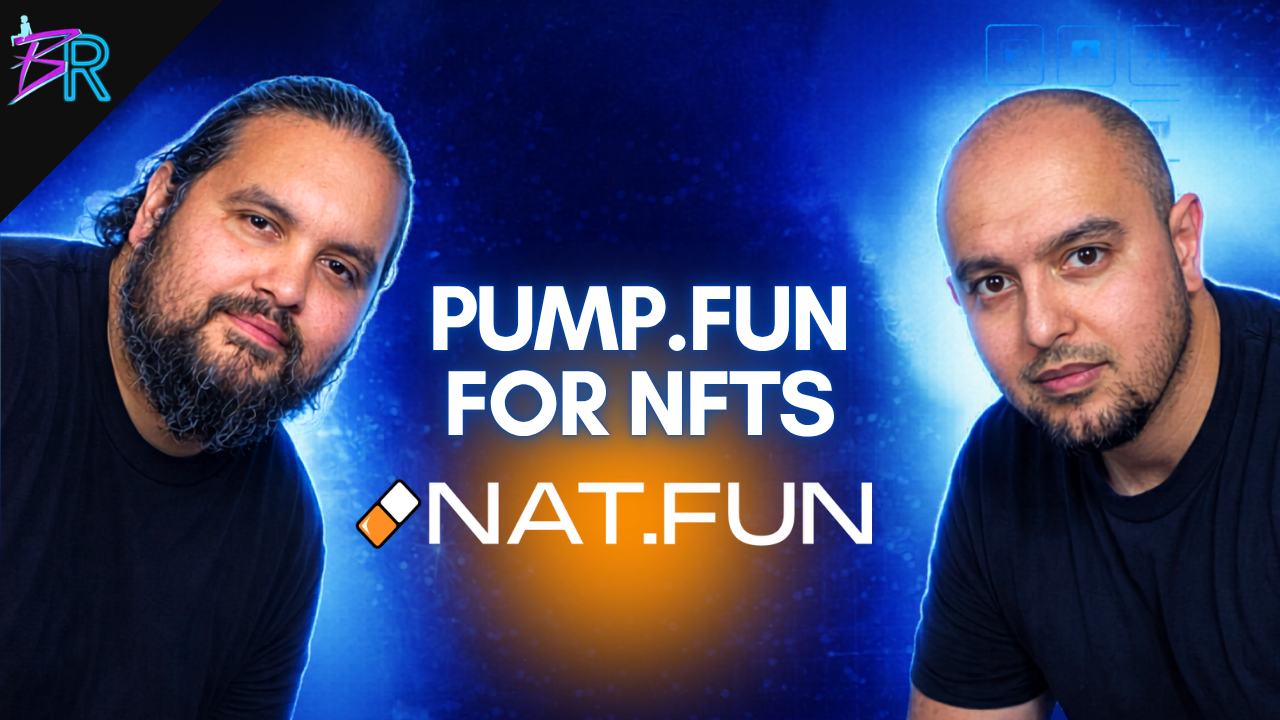
The Block Runner crew lost their internet. So naturally, they sat down and recorded a podcast anyway.
Episode 308 opens with William, Iman, and TJ staring at laptops that are essentially decorative. No search engine, no dashboard, no agents. Just three guys in a room with a camera and a lot to say. What followed was one of the most unfiltered, idea-dense episodes in the show's history: a full breakdown of the NAT.fun platform, the philosophy of non-arbitrary tokens, and a frank assessment of why crypto's innovation drought is both a crisis and an opportunity.
Before diving into the platform, the crew talked shop about what it actually takes to compete for attention in 2026. William described a crypto YouTuber with 90,000 followers and a fraction of The Block Runner's video library. The difference? Highly edited, scripted content with polished hooks.
"It's like serving processed food," William said. "If you want to capture attention, you have to package things into a more hook-grabby way. But we're keeping our proprietary style. The authenticity."
The Block Runner now ships three content types: full-length podcasts like this one, spontaneous 20-minute reaction videos covering breaking news, and highly produced AI-assisted short-form pieces with scripted hooks and generated visuals. The third category is new and powered almost entirely by AI tools: Seedance for video generation, custom voice cloning for intros, and automated post-production pipelines that turn a raw recording into a finished episode in minutes.
The credibility argument was explicit. "If we're gonna talk about AI the way we talk about crypto, we have to have some sort of backing of credibility," William explained. "Our credibility for crypto comes from our track record. Ordinals, Bitmaps, DMT, Bittensor. All called early. For AI, you demonstrate credibility by actually using it."
This is where the episode pivoted from content strategy to something much bigger.
The legacy NFT model is over. Set a price, run a hype campaign, pray the mint sells out. If it does not, the creator is stuck, the community is stuck, and the entire project collapses under the weight of expectations it never had the tools to meet. The Nelk Boys era of NFTs is not coming back.
But the underlying technology? That is a different question entirely. NFTs as a primitive, a unique on-chain asset, remain perfectly functional. The problem was never the tech. It was the launch mechanism.
"If every NFT launched dumped 99%, that means nothing had any viability," William said. "There was no viability test. It was just create some hype campaign, set a price, and hope."
To understand NAT.fun, you have to understand what Pump.fun actually did. Pump.fun solved bootstrapped liquidity using bonding curves. Before Pump, launching a token required capital to seed a DEX. After Pump, any creator could deploy a token where early purchases filled the bonding curve, which then automatically seeded liquidity upon graduation. A billion dollars in annual revenue later, the model proved itself.
But Pump.fun only did one thing: meme tokens with arbitrary supplies. All one billion supply. All fungible. No NFTs. No connection to anything outside the Solana mempool.
The Block Runner crew saw something deeper. Only about one percent of tokens on Pump.fun ever graduate. That one percent filter is, effectively, a viability test. The market decides what deserves liquidity. Everything else dies on the curve.
The question became: what if you applied that viability test to NFTs?
Here is where NAT.fun departs from everything else in the space.
Every token on Pump.fun has an arbitrary supply. One billion, because someone typed it. NAT.fun tokens have non-arbitrary supplies derived from patterns in Bitcoin's block data. The name "non-arbitrary token" is literal: the supply is determined by a pattern's occurrence rate across Bitcoin's 17-year block production history.
William drew the hydrogen analogy. The word "hydrogen" is arbitrary. It could be any name. But a hydrogen atom, one proton and one electron, is not arbitrary. It is a specific, tamper-proof configuration. Apply the same logic to Bitcoin: if you find a pattern across blocks secured by nearly 200 terawatts of cumulative energy, that pattern is not arbitrary either. It inherits the thermodynamic properties of the chain that produced it.
This is Digital Matter Theory, or DMT, the framework The Block Runner has been building on for years. NAT.fun is its first consumer-facing application.
NAT began on Bitcoin Layer 1 through the TAP protocol. It hit a wall almost immediately.
Bitcoin is not built for the velocity that bonding curves and NFT distribution require. The mempool is nearly empty most of the time, not because the network is failing, but because the chain was never designed for high-frequency consumer applications. Transaction finality is slow. The developer tooling is sparse. The user experience is hostile.
So the team made a pragmatic choice: deploy on Solana while maintaining Bitcoin as the data source. Every NAT.fun token still derives its supply from Bitcoin block patterns. The connection to Bitcoin's thermodynamic security is preserved. But the trading, the bonding curves, the NFT distribution, and the user experience all run on Solana, where transactions settle in under a second.
"We did our exploration, looked at all the chains, and arrived at Solana," William said. "The only place you could do this is on Solana because the technology is there to facilitate these bonding curves."
A creator on NAT.fun selects a Bitcoin block pattern. That pattern defines the non-arbitrary supply of both the fungible token and the NFT collection. The token launches on a bonding curve with no set price. Buyers purchase tokens and simultaneously acquire proportional ownership of the NFT collection.
Buy one percent of the token supply and you own one percent of the NFT inventory. The platform shows your token balance alongside an inventory of Bitcoin blocks. It is, functionally, the commodification of Bitcoin's block production history into tradable, distributable assets.
If the token reaches a graduation threshold of roughly $100,000 market cap, a "blockout" occurs. The NFTs get distributed to token holders essentially for free. The secondary market then sets the price. No mint. No whitelist. No floor price manipulation. The market decides.
If the token never graduates, the NFTs never distribute. The viability test did its job.
There is also an expansionary element that does not exist anywhere else in crypto. Because Bitcoin keeps producing blocks, patterns can recur. Token supplies are not fixed at genesis. They expand non-arbitrarily as new blocks match the pattern. This creates a fundamentally different market dynamic from the deflationary models the industry has been fixated on.
The deeper thesis behind NAT.fun is not about NFTs or meme tokens. It is about Bitcoin's security budget.
Bitcoin miners secure the network through the block subsidy: freshly minted BTC earned per block. That subsidy halves every four years. Transaction fees have never consistently compensated for the decline. The math is simple and uncomfortable: if nothing changes, the economic incentive to mine Bitcoin weakens over time.
The NAT token, the original token from the DMT ecosystem, is a second subsidy. Miners earn NAT alongside BTC for including NAT transactions in blocks. If NAT.fun generates significant platform revenue, a substantial portion flows back into purchasing NAT, which flows back to the miners securing the network that produces the block data that makes the whole system possible.
"Imagine the platform leverages Bitcoin block data to generate these assets," William said. "We are essentially tapping into Bitcoin and leveraging that data layer as value. And because we do that, we are buying the NAT token, which brings value back to the Bitcoin miners that secure the network to begin with."
If Pump.fun proved a bonding curve platform can generate a billion dollars a year, and NAT.fun solves a real problem for NFT creators, the flywheel has fuel. That is a big if. But the architecture is designed for it.
William ended the episode with what might be the most ambitious statement in The Block Runner's seven-year history.
"Our real goal is to make an impact in crypto. I want to go on CoinGecko one day and see a toggle: arbitrary tokens or non-arbitrary tokens. And most likely NAT will be number one in the non-arbitrary space."
That is not a price target. It is a category creation target. The team is not trying to pump a token. They are trying to establish a new classification of digital assets, one rooted in Bitcoin's thermodynamic properties rather than arbitrary human decisions.
Whether it works depends on builder adoption, platform revenue, and miner participation at scale. All of those are years away. But the thesis is coherent, the platform is being built, and nobody else in the space is even attempting this.
"Nobody has thrown the jab," William said. "Not a single jab. We have been warning the team for six months: if we do not dev quicker, we are not going to be first to this punch. And still, nobody."
Episode 308 is the most complete public explanation of what NAT.fun is building and why. The crypto industry is in what William calls a "perilous state" of disappointment: innovation has migrated to AI, bonding curve clones do nothing beyond meme tokens, and the entire ecosystem is in quiet opposition to the one chain that started it all.
NAT.fun is a bet that the industry can be realigned. That NFTs can be revived through better mechanics. That Bitcoin's block data has untapped value. That creators deserve a launch mechanism that does not require them to set prices and pray.
The platform goes live soon. The AI-assisted video content drops next week. And the internet, eventually, came back on.
We covered all of this and more in Episode 308. Subscribe to The Block Runner on YouTube and at TheBlockRunner.com so you do not miss what comes next.

