
April 18, 2026
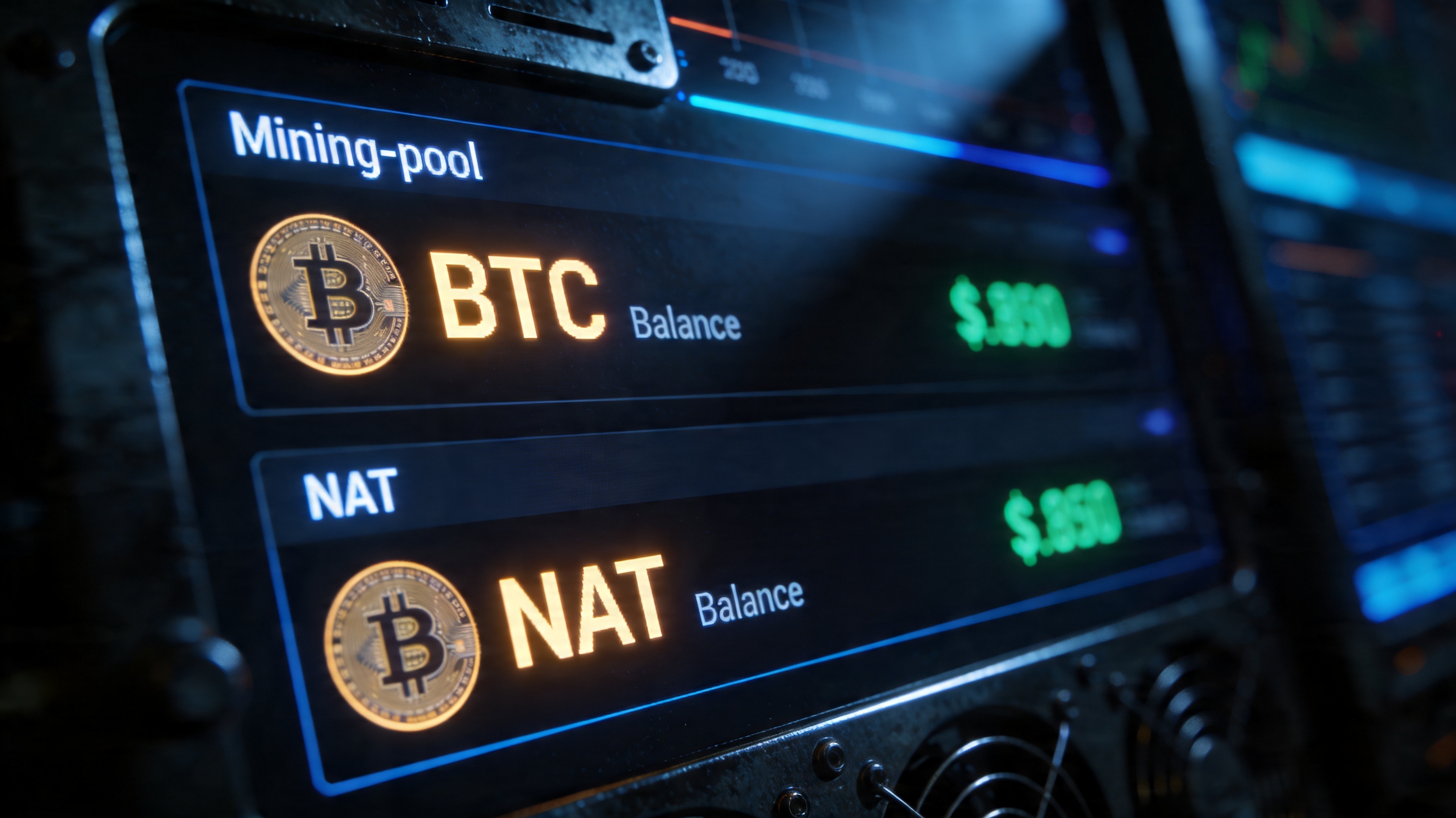
On this week's Block Runner Podcast, William and I-man opened with a topic they could barely contain: SpiderPool, the fifth-largest Bitcoin mining pool by hash rate, has announced it will begin distributing both Bitcoin and NAT tokens to pool participants — a milestone that's been in the making for six months.
*Disclosure: William and I-man are founders of NAT.fun and hold NAT tokens. All analysis in this episode reflects their perspective as participants in the ecosystem.*
It's the kind of announcement that tends to get dismissed with an eye-roll from the Bitcoin maximalist crowd. The CMO of Brains — another Bitcoin mining operation — literally replied with "lol" on social media.
William's response: "On average, that's the right instinct. But sometimes you're wrong, and this is one of those times."
The dismissal is a familiar pattern. The hosts walked through their own history of missing Pump.fun's rise, initially writing it off as meme-coin churn before recognizing the genuine technical innovation: a bonding curve mechanism that bootstrapped liquidity for tokens at scale — generating a billion dollars in revenue in under a year.
"You've got to train yourself to look into it," William said. "You can't ignore the noise. And in a lot of cases, it's very expensive not to."
The bigger context here isn't just SpiderPool. It's a fundamental problem baked into Bitcoin's design that most holders have never seriously reckoned with.
Bitcoin's value — and its security — depend on miner revenue. Right now, that revenue comes from two sources: block subsidies (newly minted Bitcoin) and transaction fees. The subsidy halves every four years. By 2140, it hits zero entirely.
The conventional response is: "Bitcoin's price will keep going up. Transaction fees will cover it."
In the hosts' model, that math doesn't hold up. For the security budget to remain adequate through the subsidy halvings, Bitcoin's price would need to follow an X² growth curve — a requirement that compounds with each halving cycle.
"X squared is a number that goes up forever, infinitely," William explained. "And there is nothing in the history of the universe that does that."
To make it concrete: in the hosts' framework, if Bitcoin's price were to follow the trajectory required to maintain its security budget on the current path, it would correlate to pricing every single grain of sand on Earth at $700 per grain.
"That analogy was basically on this. Does that sound crazy? Yeah, that's the point."
The NAT token, according to the hosts, exists specifically to address this problem. Instead of depending on Bitcoin's price to sustain security, NAT introduces a supplemental miner subsidy that doesn't decay.
The numbers William ran on-air tell the story in his model. Today, NAT delivers roughly $46 per block to miners — "about a burger and some fries," as I-man put it. Not life-changing.
But at a $1 billion NAT market cap — still 1,400 times below Bitcoin's current valuation, and only 20x higher than today's price — NAT would deliver $1,000 per block to miners, per natgmi.com projections. That puts it at rough parity with the average total transaction fees per block on Bitcoin today.
At $100 billion: $100,000 per block. Currently, miners earn about $235,000 per block from subsidy combined. In this scenario, NAT would add roughly half of today's total subsidy — without decaying.
"The reason I have a lot of confidence in what I'm saying is because this is supported by the math," William said. "This isn't something I'm just hoping for."
According to pool data at natgmi.com, approximately 60% of global Bitcoin hash power is currently participating in NAT distribution. Mining operations that have run the numbers recognize the economic case: NAT creates an alignment mechanism that makes honest mining more profitable than attacks.
"We've essentially bribed miners to be more honest by delivering more value to them for being honest miners in the network," William explained.
The hosts also addressed a question that doesn't get enough oxygen: who actually attacks Bitcoin, and when?
According to remarks by the CEO of Brains on social media, it would cost approximately $24 billion to attack the Bitcoin network for one hour. That sounds like an impenetrable defense.
But compare it to defense budgets. The United States alone spends $500 billion to $1 trillion per year on national security. If Bitcoin becomes a geopolitical asset — if nation-states hold it as strategic reserves — then $24 billion to disrupt an adversary's monetary foundation looks cheap.
"It's not about hacking people for money," William said. "It's about disrupting finance."
The current absence of attacks isn't evidence that attacks are impossible. It's evidence that Bitcoin isn't geopolitical yet. NAT's role in that scenario: by expanding the miner reward pool, it raises the economic cost of corrupting the network through bribery or coercion.
The episode's second segment shifted to NAT.fun, the platform William and his team have been building.
The thesis is direct: NFTs aren't dead because the technology failed. They're dead because the launch model failed. Every major collection launched in 2021 and after entered at inflated valuations with no mechanism for organic price discovery. The charts, universally, look like "straight-down technology."
Foundation — a marketplace with 300,000 followers — recently announced it was winding down. Follower counts don't translate to market viability.
NAT.fun's approach: every NFT collection begins with a viability test. Token creators launch through a bonding curve mechanism. If a token graduates (reaches market viability), the platform distributes NAT-native NFTs — UNATs (unique non-arbitrary tokens) — to all token holders for free.
The supply of UNATs is derived from Bitcoin block production data, making the token supply a function of on-chain signal rather than arbitrary decision.
The platform launches on Solana — not because the hosts are abandoning Bitcoin's principles, but because Solana currently has the best user experience for retail participants, and the NAT token supply mechanics preserve the Bitcoin data connection.
The episode circled back to first principles. Tokens, at their best, are alignment mechanisms. Bitcoin aligns holders to want Bitcoin to succeed. NAT does the same — but its natural side effect is that it creates an economic incentive for miners to secure the network.
"It's the only token that does that," William said.
Whether or not NAT reaches $1 billion, $10 billion, or $100 billion is an open question. The hosts' argument is that the mathematical case for a supplemental, non-decaying security subsidy is sound — and that this week's SpiderPool announcement suggests major mining operations are taking it seriously.
*The Block Runner Podcast is published weekly. Watch the full episode on YouTube and subscribe to the newsletter at TheBlockRunner.com.*
*This article summarizes the hosts' views for informational purposes only and does not constitute financial advice. The hosts hold NAT tokens and have financial interests in the projects discussed.*


